
How to Buy a Used Car in Sri Lanka (2026): The Complete Checklist
Updated October 2026. Prices, import rules, leasing limits and DMT requirements checked on 20 October 2026.
Buying a used car in Sri Lanka has rarely been this tricky. In September 2026, importers said prices of popular small cars had fallen by Rs. 300,000 to Rs. 1 million. At the same time, a 50% surcharge on vehicle import duty runs until 31 December, and banks can lend less against a car.
The paperwork has changed as well. Since 5 January 2026, the Department of Motor Traffic (DMT) needs the new owner's Taxpayer Identification Number (TIN) to transfer most vehicles.
This guide shows you how to buy a used car in Sri Lanka without getting burned. It covers what to check in the CR, how to confirm a car is not still under lease, what to inspect, how to pay safely and how the DMT transfer works. A printable checklist sits at the end.
Quick answer: how to buy a used car safely in 10 steps
- Set an all-in budget. Cover the price, DMT transfer costs, insurance and a first service. If you plan to lease, keep at least 40% of the price in cash.
- Shortlist verified sellers. Skip ads with stock photos, missing mileage or a price far below similar cars.
- Match the seller to the CR. The registered owner's name and NIC on the Certificate of Registration should match the person selling.
- Check the absolute owner. If a bank or leasing company is listed, get its settlement and release letter before you pay.
- Match chassis and engine numbers. The numbers on the car must match the CR exactly.
- Inspect and test-drive. Check the body, engine, gearbox and hybrid battery, or pay an independent mechanic.
- Put the deal in writing. A signed sale agreement should record the price, chassis number, and hand-over date and time.
- Pay traceably. Use a bank transfer or bank draft against the signed papers, and never pay an advance for a car you have not seen.
- Collect the transfer set. Take the original CR, the signed MTA 6 and MTA 8 forms and a valid revenue licence.
- Transfer within 14 days. Lodge the papers at the DMT with your NIC and TIN, then move the insurance into your name.
The golden rule: do not pay a single rupee until you have seen the original CR, matched it to the seller's NIC and checked who the absolute owner is.
The 2026 used car market in Sri Lanka: what changed
Four changes decide what you pay this year and how you pay for it.
Prices of popular small cars are falling
On 16 September 2026, the Vehicle Importers' Association of Lanka said many dealers were selling below cost. It reported drops of Rs. 300,000 to Rs. 1 million on the Toyota Yaris and Vitz, Honda Vezel, Suzuki Wagon R, Daihatsu Mira and Suzuki vans (Asian Mirror). The association expects prices to fall further before the market steadies.
Import duty stays higher until at least 31 December
A 50% surcharge on Customs Import Duty began on 16 May 2026 and has been extended to 31 December 2026. Cars imported under letters of credit opened on or before 15 May are exempt, but only if they ship by 15 November on an unamended letter of credit. A senior government source has said the surcharge may lapse at the end of the year if the rupee keeps strengthening, though importers doubt it (The Morning).
The Vehicle Importers Association of Sri Lanka expects surcharge-hit stock to cost about Rs. 500,000 more for a Wagon R and Rs. 1.5 to 2 million more for a Vezel (BusinessNews.lk).
With prices pulled both ways, similar cars can carry very different price tags. Compare at least five comparable listings before you make an offer.
Leasing now covers less of the price
From 25 May 2026, the Central Bank tightened loan-to-value limits on vehicle finance by 10 percentage points (CBSL). A car registered in Sri Lanka for more than a year can be financed up to 60% of its value. For unregistered cars and those registered within the last year, the cap is 40% for cars, SUVs, vans and three-wheelers (Newswire).
In practice, a Rs. 8 million car registered two years ago needs at least Rs. 3.2 million in cash, before fees.
You need a TIN to transfer a car
Since 5 January 2026, the DMT requires the new owner's TIN, entered with their NIC number, for registrations and ownership transfers. Motorcycles, three-wheelers, tractors, tractor trailers and hand tractors are exempt (Sri Lanka Mirror).
From 1 November 2026, the Inland Revenue Department also requires a valid TIN certificate to register a vehicle or renew its licence. A printout of the IRD's online TIN verification showing your NIC and TIN is accepted instead (Asian Mirror). No TIN yet? Register on the IRD e-Services portal before you start viewing cars.
What used cars cost on buyme.lk (October 2026)
These asking prices were live on buyme.lk on 20 October 2026. They are sellers' asking prices, not final sale prices.
- Suzuki Alto (2016): Rs. 3,775,000
- Mazda Demio (2007): Rs. 4,780,000
- Suzuki Wagon R FZ Safety (2014): Rs. 5,800,000
- Suzuki Wagon R (2018): Rs. 7,100,000
- Honda Vezel (2014): Rs. 9,400,000
- Toyota Axio (2016): Rs. 12,300,000
- Toyota C-HR (2018): Rs. 14,900,000
For comparison, a brand-new 2026 Wagon R was listed at Rs. 9,300,000. Browse the latest used vehicles for sale on buyme.lk and filter by model year, mileage, fuel type and verified sellers.
How much should you budget for a used car?
Budget for the full cost of getting the car on the road, not just the asking price.
- Purchase price. Asking prices usually leave room to negotiate, so research what similar cars have sold for.
- DMT transfer costs. The DMT charges a fee by vehicle class, and the one-day service costs more. Fees change by gazette, so confirm the amount at the counter.
- Insurance. Third-party cover is compulsory. Get a comprehensive quote before you commit, because the premium depends on the car's value and model.
- Revenue licence and emission test. If the licence is about to expire, you pay for the renewal, and most cars need a valid emission test certificate first.
- Repair reserve. Keep money aside for tyres, a battery, a full service and anything the inspection finds.
- Down payment, if you lease. Lenders can finance at most 60% of a car registered for over a year, and they value the car themselves. Get pre-approval before you negotiate, so a low valuation does not surprise you.
How to shortlist used cars and spot risky ads
A good shortlist saves wasted viewings and screens out most scams. On buyme.lk, filter cars for sale by model year, mileage, fuel type and transmission, and tick Verified sellers only.
Skip or question any ad that shows these warning signs:
- A price far below similar cars of the same year and mileage.
- Stock photos, or photos that hide the number plate and the dashboard.
- No mileage, or mileage that looks too low for the car's age.
- A seller who avoids phone calls, says they are overseas, or wants a deposit before a viewing.
- Pressure to decide today.
Ask these questions before you travel to see the car:
- Are you the registered owner named on the CR?
- Is the car under a lease or loan, and who is the absolute owner?
- How many owners has it had, and is there a service record?
- Has it been in an accident or a flood?
- When do the revenue licence and insurance expire?
How to check the CR (Certificate of Registration) before you buy
The CR is the car's legal identity, so check it before you look at anything else. Compare each field with the seller's NIC and with the car in front of you.
- Registered owner. The name and NIC number should match the seller's NIC. Red flag: the seller is "selling for a friend" or offers pre-signed blank forms.
- Absolute owner. This should be blank, or name a finance company that has issued a settlement and release letter. Red flag: a finance company is listed and there is no release letter.
- Chassis and engine numbers. Both must match the numbers stamped on the car. Red flag: scratched, re-stamped or mismatched numbers.
- Year of manufacture and first registration. Both should match what the ad claims. Red flag: the ad shows a newer year than the CR.
- Fuel type, engine capacity, colour and class. All should match the car you are viewing. Red flag: the colour or engine has changed but the CR has not been updated.
- The document itself. You should see the original CR. Red flag: only a photocopy, or a recently issued duplicate.
Always see the original CR. A duplicate can be legitimate, but the DMT issues one only against a police complaint about the lost original, so ask why it was needed.
Avoid "open paper" deals, where the owner has signed the transfer forms but the car was never registered to later buyers. You inherit an unknown history, and the legal owner may be someone you have never met.
Finally, check the supporting papers. You need a revenue licence that is valid on the day of transfer, plus the emission test certificate, insurance certificate and service records. For a recently registered Japanese reconditioned car, also ask for the auction sheet, which records its auction grade, mileage and repairs.
How to check if a vehicle is under lease or finance
If a bank or leasing company is named as the absolute owner on the CR, the seller cannot pass on clear ownership until that facility is settled. Handle it in this order:
- Ask the seller for the finance company's name and the facility number.
- Call the finance company on the number from its official website, not one the seller gives you, and ask for the settlement amount.
- Pay the settlement directly to the finance company, and pay only the balance to the seller.
- Get the finance company's letter on its letterhead asking the DMT to cancel its absolute ownership. The letter must state the vehicle number.
- Sign the transfer papers only after you hold that letter.
Some lenders let a buyer take over an existing lease, but only with the lender's written approval.
Never accept a promise that the lease "will be settled after you pay". Once your money is with the seller, you have no leverage.
What to inspect on a used car in Sri Lanka
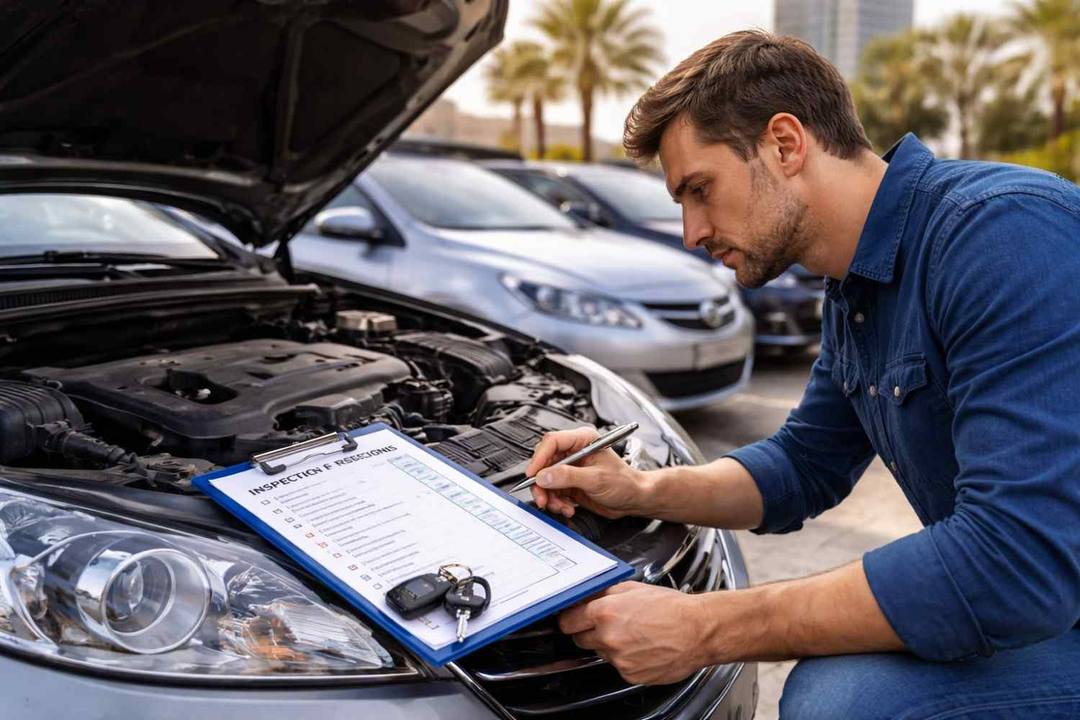
Inspect in daylight on a dry day, with the engine cold, and bring someone who knows cars. Work through each area below and photograph anything that worries you.
Body and accident repairs
- Uneven panel gaps, colour differences between panels, or paint overspray on rubber seals.
- Welding marks or wrinkled metal in the boot floor, engine bay and door frames.
- Repainted panels, which a low-cost paint thickness gauge shows in seconds.
- An airbag warning light that stays on after start-up.
Engine and gearbox
- Start the engine cold and listen for rattles or knocking.
- Watch the exhaust. Blue smoke suggests burning oil, thick white smoke suggests coolant, and black smoke suggests a fuel problem.
- Check under the oil cap for a milky residue, and look under the car for fresh leaks.
- In an automatic or CVT, take-off should be smooth, with no judder, slipping or delay. In a manual, a very high clutch bite point means a worn clutch.
Hybrid and electric batteries
Popular hybrids such as the Toyota Aqua, Prius and Axio hybrid and the Honda Vezel need extra checks. Ask for a recent hybrid battery health report from a garage with a diagnostic scanner. For an electric car, ask for the battery state-of-health reading.
On the test drive, a healthy hybrid runs on electric power at low speed without the engine constantly starting and stopping. Treat any hybrid system warning as a deal-breaker until a technician has diagnosed it.
Flood damage
Cars caught in the late-2025 cyclone floods can still turn up for sale, and the CR does not record water damage. Check for these signs:
- A musty smell, damp carpets, or brand-new carpets in an older car.
- Silt, mud or rust under the seats, on seat rails, in the spare-wheel well and at the ends of seat belts.
- Misted headlights, corroded connectors and electrics that work only some of the time.
Mileage
- Compare the odometer with the service records and, for Japanese imports, the auction sheet.
- Look for wear on the steering wheel, pedals, gear knob and driver's seat that does not match a low reading.
- A diagnostic (OBD) scan reads stored fault codes, and on some models it also shows mileage held in other modules.
Get an independent inspection
If you are not confident, pay an independent mechanic or the brand's authorised service centre for a pre-purchase inspection with a written report. A seller who refuses an inspection is telling you something.
How to test-drive a used car properly
Drive for at least 20 minutes on mixed roads, including traffic, a hill, a rough patch and an open stretch. Carry your driving licence and have the seller in the car.
- Run the air conditioning on full; the cabin should cool quickly.
- Brake firmly on a clear road. The car should stop straight, with no pull or shudder.
- Listen for clunks over bumps and feel for the steering pulling to one side.
- Keep an eye on the temperature gauge; it should stay steady.
- Test every window, mirror, light, the reversing camera and the infotainment screen.
- After the drive, look under the car again for fresh leaks.
How to negotiate and agree the deal in writing
Negotiate with evidence, then write down everything you agreed. Your inspection findings and comparable listings are your strongest arguments.
Agree who pays the DMT transfer costs and any lease settlement. Fix the hand-over date and time too, because the seller stays the registered owner until the DMT records the transfer.
A simple sale agreement should include:
- Full names, NIC numbers and addresses of the buyer and seller.
- Registration, chassis and engine numbers, and the odometer reading.
- The agreed price, the payment method and any settlement paid to a lender.
- The hand-over date and time.
- Any defects the seller disclosed, and a line stating the car is sold as inspected.
- Signatures of both parties, ideally with two witnesses.
Buying from a dealer? Get a proper invoice and any warranty terms in writing.
How to pay for a used car safely
- Pay by bank transfer or bank draft into an account in the registered owner's name.
- Hand over the payment and collect the documents at the same meeting, ideally at a bank.
- Never pay an advance to reserve a car you have not seen. If a dealer asks for a reservation deposit, get a receipt that says when it is refundable.
- Avoid carrying large amounts of cash. If you must pay cash, count it at a bank and get a signed receipt.
- Never release money against photocopies. Leave with the original CR, the signed transfer forms, the revenue licence, every key and the service book.
How to transfer vehicle ownership at the DMT in 2026
A transfer uses two forms. MTA 6 records the change of possession, and MTA 8 is the application to register the car in the new owner's name. Seller and buyer each have a job, and both must act within 14 days of the sale.
What the seller does
- Fills in and signs all four copies of MTA 6 (A, A1, B and B1).
- Keeps copies A and A1, and gives the buyer copies B and B1 with the MTA 8 forms, the original CR and the revenue licence.
- Notifies the Commissioner General of Motor Traffic within 14 days, by sending copy A by registered post, by hand, or by WhatsApp to 076 883 3300.
What the buyer does
- Completes the MTA 8 application (copies C and C1).
- Hands in MTA 6 copy B and MTA 8 copy C with the documents below, within 14 days of the sale.
- Collects the CMT 52 receipt and keeps copies B1 and C1 until the new CR arrives.
You can lodge a normal transfer at the DMT head office in Narahenpita (Colombo 05), a district Motor Traffic office or the relevant Divisional Secretariat. Counters accept transfers from 9.00 am to 2.00 pm on weekdays.
Documents to take to the DMT
- MTA 6 copy B and MTA 8 copy C.
- The original CR.
- Your NIC and a photocopy, plus your TIN. The TIN is not needed for motorcycles, three-wheelers and tractors.
- A revenue licence valid on the transfer date, and a photocopy.
- Recent photographs as the MTA 8 form specifies; one is pasted on copy C.
- The finance company's release letter, if the car was leased or mortgaged.
- Luxury tax receipts, if any were due.
- Your marriage certificate, if your name changed after marriage.
- For the one-day service, the seller's no-objection letter and NIC copy, both certified.
Requirements change, so confirm the list with the transfer branch before you go.
Normal service or one-day service?
Normal service
- Where: the DMT head office, district Motor Traffic offices or Divisional Secretariats.
- Counter hours: 9.00 am to 2.00 pm on weekdays.
- New CR: posted to you later.
- Cost: the standard transfer fee.
One-day service
- Where: the DMT head office only.
- Counter hours: 9.00 am to 12.00 noon on weekdays.
- New CR: issued the same day.
- Conditions: you attend in person with the original CR. A car can have only one one-day transfer in six months, and the service is not available for a deceased owner's car or state vehicles.
- Cost: higher than the normal service.
The 14-day rule
The DMT has said late transfers attract a fine of up to Rs. 100,000 for cars, vans, lorries and buses, and up to Rs. 50,000 for three-wheelers and motorcycles (Daily Mirror). Until the transfer is recorded, the seller remains the registered owner, with the fines and liability that come with it.
Save these two DMT WhatsApp numbers. Sellers can send MTA 6 copy A to 076 883 3300. Written complaints about registration delays or irregularities go to 074 245 3300 (BusinessNews.lk).
After you buy: insurance, revenue licence and first service
- Insurance. Put a policy in your own name from the hand-over time. The seller's policy is a contract between the seller and the insurer.
- Revenue licence. Note the renewal date. You can renew online through eRL 2.0 once the car has a valid emission test, and from 1 November 2026 you also need your TIN certificate.
- First service. Change the oil and filters, replace the brake fluid and coolant if due, and check the tyres' age and the battery.
- Paperwork. Keep the sale agreement, payment proof, CMT 52 receipt and MTA copies. When the new CR arrives, check every detail on it.
Common used car scams in Sri Lanka and how to avoid them
Most used car scams rely on speed and trust, so slow down and verify everything yourself.
- Advance-payment ads. A cheap car, a seller who is "overseas" or busy, and a request for a deposit or transport fee before a viewing. Protect yourself: never pay before you have seen the car and the original CR in person.
- The seller is not the owner. Someone sells "for a relative" or offers pre-signed forms. Protect yourself: deal only with the registered owner, or with someone holding a valid power of attorney.
- Hidden lease. The CR names a finance company as absolute owner, and the seller takes your money without settling. Protect yourself: pay the lender directly and get its release letter first.
- Odometer rollback. The mileage is wound back to lift the price. Protect yourself: check service records, interior wear, the auction sheet and an OBD scan.
- Tampered numbers or forged papers. Chassis or engine numbers are ground off or re-stamped to hide a stolen or illegally assembled car. Protect yourself: match every number to the CR, and walk away from any sign of tampering.
- Flood or crash rebuilds. A repaired write-off is sold as a clean car. Protect yourself: get an independent inspection and use a paint thickness gauge.
- Open paper sales. The transfer forms are signed, but ownership is never registered. Protect yourself: register the transfer in your name within 14 days.
- Bait and switch. The car at the viewing differs from the ad in year, grade or condition. Protect yourself: compare the car with the ad and the CR, and leave if they differ.
If a deal feels rushed, walk away. There will always be another car.
Dealer, private seller or unregistered car: which suits you?
Each route trades price against paperwork, history and risk.
Buying from a private seller
- Price: often the lowest, with the most room to negotiate.
- Paperwork: you check and handle everything yourself.
- History: the owner's own records and service book.
- Warranty: usually none.
- Maximum lease: 60% if the car has been registered for over a year.
- Main risk: a hidden lease or fraud.
Buying a registered car from a dealer
- Price: higher, because it includes the dealer's margin.
- Paperwork: the dealer usually handles the transfer, but you still check the CR.
- History: varies, so ask for an inspection report.
- Warranty: sometimes a short written warranty.
- Maximum lease: 60% if the car has been registered for over a year.
- Main risk: undisclosed repairs.
Buying an unregistered car (reconditioned or brand new)
- Price: the highest, because it carries import duty and first registration.
- Paperwork: the dealer registers the car in your name; ask for the import papers and auction sheet.
- History: the auction grade and mileage for Japanese imports.
- Warranty: depends on the seller, so get the terms in writing.
- Maximum lease: 40% for cars, SUVs and vans.
- Main risk: price swings while the import surcharge lasts.
Find all three in the vehicles category on buyme.lk, and use the Condition filter to switch between new and used.
Printable used car checklist
Print this or save it to your phone before you view a car.
Before you view
- Budget covers transfer costs, insurance, repairs and any down payment.
- TIN registered (not needed for motorcycles or three-wheelers).
- Seller confirmed as the registered owner, and lease status known.
- Price compared against at least five similar listings.
At the viewing
- Original CR seen; the owner's name and NIC match the seller.
- Absolute owner field checked.
- Chassis and engine numbers match the CR.
- Body, engine, gearbox, hybrid battery and flood signs checked.
- A 20-minute test drive done, with the AC, brakes, steering and electrics working.
- Independent inspection report, if you are unsure.
Before you pay
- Lender paid directly and release letter received, if the car was leased.
- Sale agreement signed, with the hand-over date and time.
- Payment by bank transfer or draft to the registered owner's account.
- Originals collected: CR, MTA 6 copies B and B1, MTA 8 forms, revenue licence, all keys and the service book.
Within 14 days
- Seller has sent MTA 6 copy A to the DMT.
- Transfer lodged at the DMT, and the CMT 52 receipt kept safe.
- Insurance in your name.
- New CR checked carefully when it arrives.
Frequently asked questions
What documents do I need to transfer vehicle ownership in Sri Lanka?
You need the original CR, MTA 6 copy B signed by the seller, your completed MTA 8 (copy C), your NIC and TIN, and a revenue licence valid on the transfer date. Add photographs as the MTA 8 form specifies, and a release letter if the car was leased.
How long do I have to transfer a vehicle after buying it?
You have 14 days. The seller must notify the DMT by sending MTA 6 copy A, and the buyer must lodge the transfer within the same period. Late transfers attract fines.
How can I check if a car is under lease in Sri Lanka?
Look at the absolute owner field on the CR. If a bank or finance company is named, the car is under a lease, loan or mortgage. Get the settlement figure from the lender, pay the lender directly and collect its release letter before paying the seller.
What is the difference between the registered owner and the absolute owner?
The registered owner uses the car and is responsible for it. The absolute owner holds legal title, usually a finance company until a lease or hire purchase is paid off. Without the absolute owner's release, the car cannot be transferred cleanly.
Do I need a TIN to buy a car in Sri Lanka?
Yes, to transfer most vehicles into your name. Since 5 January 2026, the DMT has required the new owner's TIN with their NIC number, except for motorcycles, three-wheelers and tractors. From 1 November 2026, you also need a TIN certificate to renew a revenue licence.
Can I get the new CR on the same day?
Yes, through the one-day service at the DMT head office. You must attend in person with the original CR, and the car must not have had a one-day transfer in the past six months. It costs more than the normal service, where the new CR is posted to you.
How much can I borrow to buy a used car in 2026?
For a car registered in Sri Lanka for more than a year, banks and leasing companies can lend up to 60% of its value. For unregistered cars and those registered within the last year, the limit is 40% for cars, SUVs, vans and three-wheelers.
Is it safe to pay a deposit to reserve a car?
Only to a business you can verify, against a written receipt that states the refund terms. Never pay an advance to a private seller for a car you have not seen, or to anyone who cannot show the original CR.
Should I buy now or wait for prices to fall?
Nobody can time the market reliably. Importers reported falls of Rs. 300,000 to Rs. 1 million on popular small cars in September 2026, but the import surcharge runs until 31 December. If you need a car now, a well-checked car at a fair price beats waiting for a perfect moment.
Find your next car with confidence
A used car purchase goes well when you verify the owner, the lease status and the numbers before any money moves. Take your time, get the car inspected and finish the DMT transfer within 14 days.
Ready to start? Browse used cars from verified sellers on buyme.lk. Selling instead? Get your CR and service records ready, then post your car ad on buyme.lk and reach serious buyers across Sri Lanka.
This guide is general information, not legal or financial advice. Fees and procedures change, so confirm current requirements with the DMT before you transfer.